Robert Smalls and the Theft of Freedom
He stole a Confederate warship in the middle of the night, sailed it past five checkpoints, and delivered it to the Union Navy. Then he went to Congress. The story of Robert Smalls is the story of what Black Americans did with freedom the moment it became possible to seize it.
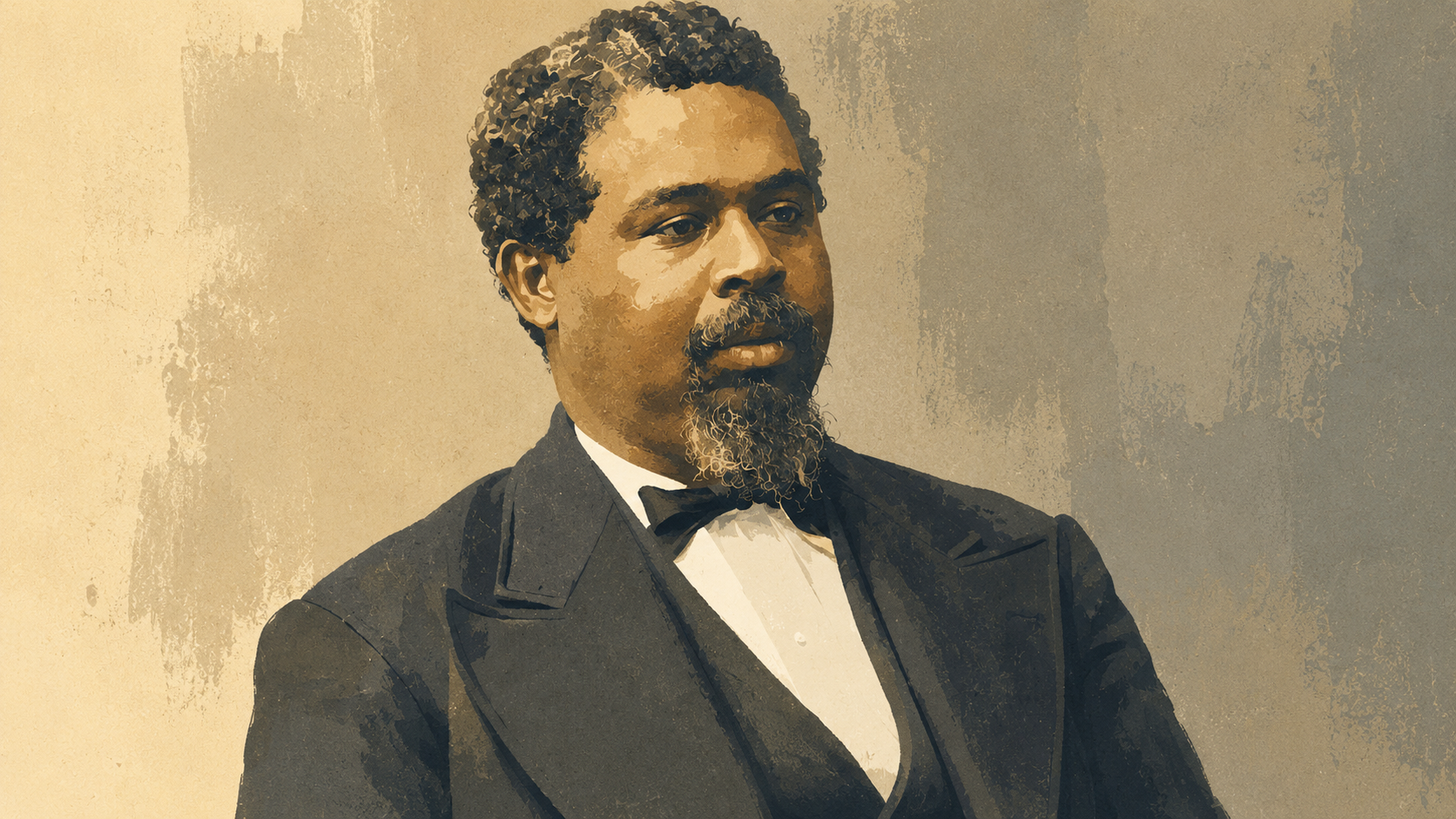
On the morning of May 13, 1862, a Confederate transport ship called the CSS Planter moved through the harbor at Charleston, South Carolina, under the command of a man the Confederacy considered property.
Robert Smalls, the ship's enslaved wheelman, had spent months watching. He had studied the captain's mannerisms, memorized the signal sequences required to pass Confederate checkpoints, observed the precise protocol for navigating Charleston Harbor under military jurisdiction. And on the night of May 12th, when the white officers left the ship to spend the night ashore, he moved.
Smalls gathered his family, the families of his crew, and sixteen people in total — enslaved men, women, and children — and sailed the Planter out of Confederate waters in the darkness. He wore the captain's uniform. He replicated the captain's signature gestures at each checkpoint. He passed five Confederate forts. He steered directly toward the Union blockade, raised a white flag, and surrendered the ship, its cargo, its armaments, and himself to the United States Navy.
It was one of the most audacious acts of self-liberation in American history. And it was only the beginning.
What He Took and What He Delivered
The CSS Planter was not a minor vessel. It was a 147-foot side-wheel steamship that had been actively used by Confederate forces for transport, communication, and military logistics throughout the Charleston harbor — one of the most strategically significant ports in the Confederacy.
What Smalls delivered to the Union Navy was therefore not simply a ship. It was a comprehensive intelligence asset.
He brought detailed knowledge of Confederate harbor defenses, including the locations of mines, torpedoes, and fortifications that Union commanders had been unable to map from the outside. He brought the ship's code books and signal protocols — the precise sequences he had used to pass the Confederate checkpoints, now available to Union forces planning naval operations in the region. He brought the ship itself, which was immediately pressed into Union service and ultimately used throughout the remainder of the war.
The Union Navy was sufficiently impressed that Smalls was paid a prize for the vessel. Congress passed a resolution acknowledging his contribution. He became the most celebrated Black military figure of the early war period — and used that visibility with deliberate strategic intention.
The Argument He Made to Lincoln
Less frequently told than the escape itself is what Robert Smalls did with the access it gave him.
In August 1862, Smalls traveled to Washington and met with Secretary of War Edwin Stanton and, through channels opened by that meeting, contributed to the conversations surrounding one of the most consequential military policy decisions of the war: whether to allow Black men to enlist in the Union Army.
At the time, official Union policy prohibited Black military service. The arguments against it were multiple — concerns about white soldier morale, skepticism about Black military capability, political calculations about border states that had not seceded but retained slavery. Smalls's counterargument was not abstract. He was standing in the room as living evidence of what Black men were capable of under conditions of extreme danger, with extraordinary stakes, requiring intelligence, courage, and precise execution.
His advocacy, combined with the broader pressure of military necessity and abolitionist organizing, contributed to the shift in Union policy that produced the creation of the United States Colored Troops — the 180,000 Black soldiers who ultimately served in the Union Army, comprising approximately 10% of total Union forces by the war's end. Their service was militarily decisive in a conflict that had become a war of attrition, and their participation permanently altered the political argument about Black citizenship.
Smalls did not make that happen alone. But he was in the room, making the argument, with a credibility that most advocates for that policy did not possess.
The Architect of Black Public Education
The postwar period revealed another dimension of Smalls's vision that is rarely centered in accounts of his life.
During Reconstruction, Smalls became one of the most consequential political figures in South Carolina — a state where, by the war's end, Black Americans constituted a majority of the population and, for the first time in American history, exercised genuine political power.
Among his most enduring contributions was his role in establishing free public education in South Carolina — one of the first public school systems open to all children regardless of race in any former Confederate state. The significance of this is difficult to overstate.
For a community that had been legally prohibited from literacy, the creation of accessible public education was not simply a social reform. It was the construction of infrastructure for every form of advancement that would follow — economic, political, professional, and cultural. The children who attended those schools were the parents and grandparents of the generation that organized the Civil Rights Movement. The institutional foundation Smalls helped build during Reconstruction created compounding advantages that extended across generations, even through the violence of the Jim Crow era that dismantled so much of what Reconstruction built.
Five Terms in Congress
From 1875 to 1887, Robert Smalls served five terms in the United States House of Representatives — a record of sustained political service that few politicians of any era, any race, achieve under favorable conditions. That Smalls achieved it as a Black man in post-Reconstruction South Carolina, during a period of escalating racial terror and the systematic dismantling of Black political rights, makes the record more remarkable still.
His congressional service covered the precise period during which Reconstruction was being reversed — when federal troops were withdrawn from the South, when white supremacist organizations used violence to suppress Black voting, when the legal and political architecture of Jim Crow was being assembled.
Smalls fought it at every stage. He spoke on the House floor against the policies that were dismantling Black political power. He advocated for federal protection of Black voters in the South. He challenged the fraudulent elections being used to remove Black officeholders across the former Confederacy.
He lost most of those fights. The dismantling of Reconstruction proceeded despite his opposition and the opposition of every Black political voice of the era. But the record of that opposition — the documented fact that Black Americans did not quietly accept the reversal of their rights, that they fought for those rights with every tool available to them in every forum they could access — is part of the historical record that Smalls helped create and preserve.
The Overlooked Architecture of His Legacy
What makes Robert Smalls's story different from the typical account of individual heroism is the sustained, systemic nature of what he built across his lifetime.
The escape from Charleston Harbor was extraordinary. But its deepest significance was not the escape itself — it was what Smalls understood about the nature of the moment and what he did with it. He did not simply flee slavery. He extracted from that act of liberation every possible lever of influence and used each one intentionally: his military credibility to advocate for Black enlistment, his political profile to build educational infrastructure, his congressional seat to fight the reversal of Black civil rights.
He understood, in practice and before most people had the language for it, that freedom without infrastructure is temporary. That individual liberation, without the institutional building that converts personal freedom into community capability, is one generation deep at most.
The schools he helped build outlasted the political conditions that would have prevented them. The military policy his advocacy helped shift produced soldiers whose service permanently altered the citizenship argument. The congressional record he created documented the existence and capability of Black political leadership during a period when white supremacist ideology was working to erase both.
He was building something that was meant to last longer than he did.
Why This Moment Belongs in the Current Conversation
Robert Smalls sailed into Union waters on May 13, 1862 — 164 years ago today.
The questions his life raised have not been resolved by the distance between his era and ours. The relationship between individual courage and collective infrastructure. The gap between political rights formally granted and political power actually exercised. The question of what Black Americans should do with freedom — and what structures they must build to ensure that freedom compounds rather than erodes across generations.
These are not historical questions. They are present ones.
Smalls's answer — build schools, build political institutions, build economic infrastructure, document the record, fight at every available forum, use every moment of visibility with deliberate strategic intention — remains as relevant to the current moment as it was to his.
The ship he sailed out of Charleston Harbor is long gone. The argument it made is still being made.
Essential Reading and Resources
Be Free or Die: The Amazing Story of Robert Smalls' Escape from Slavery to Union Hero by Cate Lineberry — The most comprehensive modern account of Smalls's life, from his childhood in slavery through his congressional career. Essential reading for anyone serious about understanding the full scope of his contributions.
PBS American Experience: Reconstruction — America After the Civil War — Documentary series contextualizing Smalls's political career within the broader story of Reconstruction and its dismantling. Provides the political environment without which Smalls's choices cannot be fully understood.
National Park Service Profile: Robert Smalls and the Planter — A detailed account of the escape itself, with historical documentation of the ship, the crew, and the military significance of the event.
- Filed under
- History
- Reading time
- 10 min
- Author
- Editorial Desk