Before the Panels: Black Women and the Fight to Own Their Stories in Comics
The comic book industry spent decades deciding which stories were worth telling. In 1993, a group of Black women — and the movement they helped build — decided to answer that question themselves.
In the summer of 1947, a Black journalist named Orrin Cromwell Evans published a comic book that Time magazine called "the first to be drawn by Negro artists and peopled entirely by Negro characters."
All-Negro Comics — published in Philadelphia in June 1947 — featured original characters including Lion Man, a college-educated Black American scientist working in Africa, and Ace Harlem, a hard-boiled Black detective. It was written entirely by Black writers and illustrated entirely by Black artists. It sold for fifteen cents — five cents more than the typical comic of its era, a pricing decision that likely limited its distribution from the start.
Evans had planned a second issue. He never published one.
His newsprint suppliers refused to sell to him. Historical accounts suggest the refusal was not accidental — that white rival publishers, including Parents Magazine Press and Fawcett Comics, may have pressured vendors to deny Evans the materials he needed to continue. With no newsprint, there was no second issue. Evans's attempt to build Black-owned infrastructure within the comics medium was eliminated not through competition, but through deliberate denial of access.
All-Negro Comics would remain a singular artifact — a single issue — for forty-six years. Until 1993.
The Year Everything Changed
Nineteen ninety-three is one of the most consequential years in the history of Black comics — and it has never fully received that designation in mainstream cultural memory.
In February 1993, Turtel Onli — a Chicago artist, educator, and publisher who had been creating Afrocentric comics since the 1970s — organized the inaugural Black Age of Comics Convention at the South Side Community Art Center in Chicago's historic Bronzeville neighborhood. The convention drew more than 1,000 creators and comic fans and launched what Onli would formalize as the Black Age of Comics movement — a deliberate parallel to the "Golden Age," "Silver Age," and "Bronze Age" periodizations that defined mainstream comics history. Onli defined the Black Age as "a genre of graphic novels that feature creators and products derived from the Black, urbane, indie, African or cosmic experience."
That same month, Milestone Media — founded by Dwayne McDuffie, Denys Cowan, Michael Davis, and Derek T. Dingle — launched its first titles through a landmark distribution agreement with DC Comics. The deal was structured to give Milestone something almost unprecedented in the industry: full creative control and copyright ownership over its characters while leveraging DC's distribution infrastructure. Hardware, Icon, Blood Syndicate, and Static all debuted in 1993. Milestone's first four titles sold more than three million copies in their first year, becoming the largest Black-owned enterprise in the history of the comics industry.
McDuffie had articulated the problem he was solving with characteristic directness: "If you do a Black character or a female character or an Asian character, they aren't just that character. They represent that race or that sex. Superman isn't all white people and neither is Lex Luthor. We knew we had to present a range of characters within each ethnic group, which means we couldn't do just one book."
Within this charged creative moment — the Black Age Convention launching, Milestone proving that Black-owned comics could reach mainstream scale — Black women were building their own spaces.
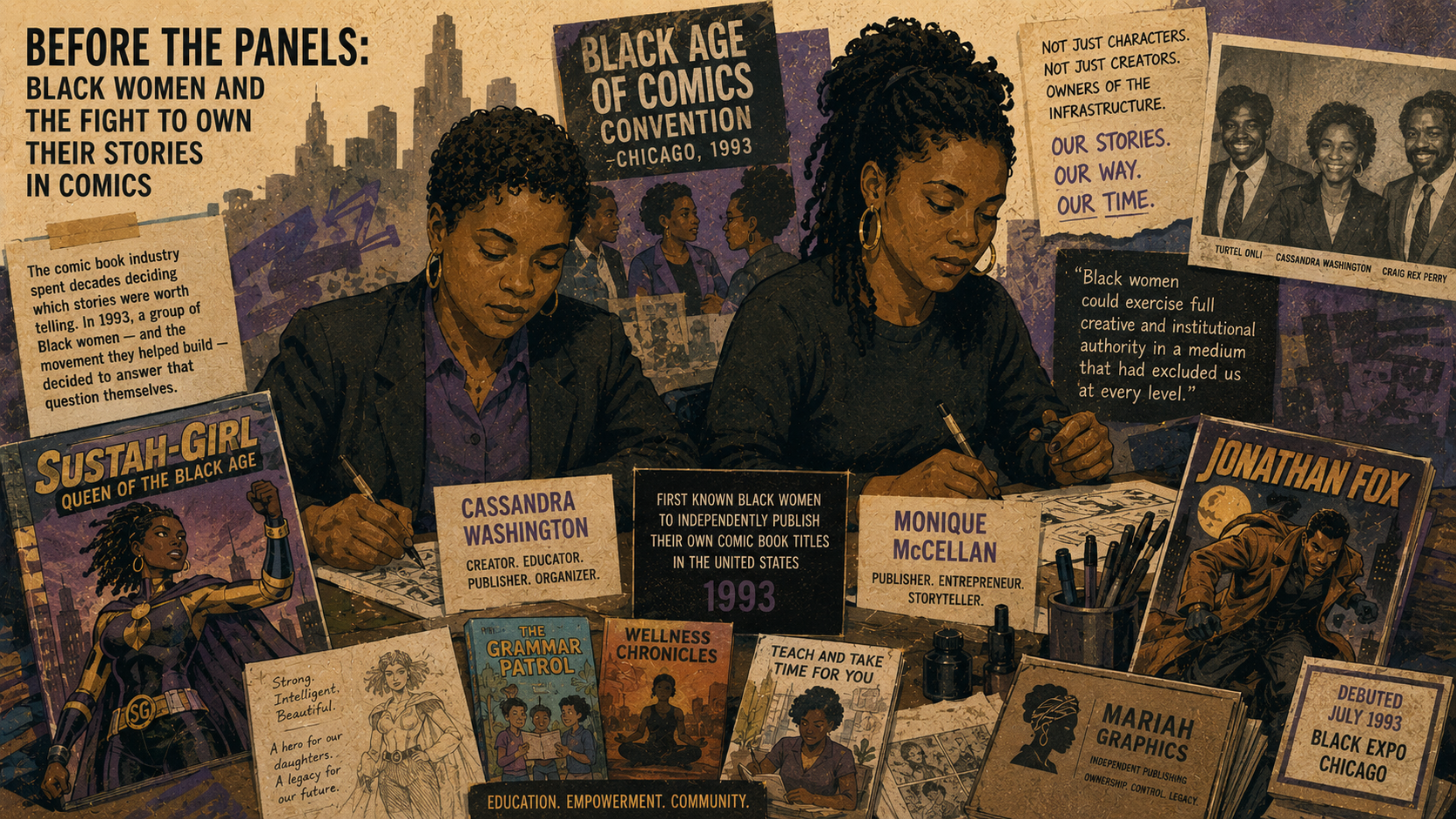
Cassandra Washington and the Making of Sustah-Girl
Cassandra Washington — educator, publisher, and writer — was among the organizers of the inaugural Black Age of Comics Convention alongside Turtel Onli and Craig Rex Perry. Her involvement was not peripheral. She was part of the team that helped give the movement its foundational public moment.
That same year, Washington co-created Sustah-Girl: Queen of the Black Age — a title whose name directly invoked the Black Age framework and whose character represented a deliberate answer to the near-total absence of Black female superheroes in American comics. Sustah-Girl was described as strong, intelligent, and beautiful — a character designed to reflect the full dignity and capability of Black women in a medium that had almost exclusively reserved that treatment for white male characters.
Washington's academic background — she holds a B.A. in Political Science and an M.A. in Teaching — informed her understanding of what representation meant beyond entertainment. Her subsequent publishing work, including The Grammar Patrol educational comic, Wellness Chronicles, and Teach and Take Time for You, reflects a consistent philosophy: that storytelling and education are not separate functions but expressions of the same commitment to community empowerment.
The significance of Washington's work in 1993 extends beyond the character she helped create. She was simultaneously building a publication, helping organize a movement, and demonstrating that Black women could exercise full creative and institutional authority within a medium that had historically excluded them at every level — as characters, as creators, and as owners of the infrastructure through which stories were told.
Monique McCellan and the Jonathan Fox Series
In July 1993, Monique McCellan debuted the Jonathan Fox series through her independent publishing operation, Mariah Graphics, at the Black Expo in Chicago — one of the largest gatherings of Black business and cultural activity in the Midwest.
The timing and venue were deliberate. Launching at the Black Expo connected McCellan's comic directly to the economic and cultural infrastructure of Black Chicago — placing it within the context of Black enterprise rather than presenting it as a subcultural curiosity seeking mainstream validation.
McCellan's decision to found her own publishing company — to control the full means of production from concept through printing and distribution — placed her within a tradition of Black independent publishing that stretches across more than a century. But within the specific context of comics, it marked something new: a Black woman exercising complete institutional authority over a sequential art publication, without partnership with or permission from any existing publisher.
Together, Washington and McCellan are recognized as the first known Black women to independently publish their own comic book titles in the United States — a milestone achieved within a single year, within the same city, within the same movement, and against the same backdrop of systematic exclusion from mainstream publishing that had defined the medium's relationship to Black creators since its origins.
The Lineage They Were Joining
To understand what Washington and McCellan built in 1993, it is necessary to understand the tradition they were extending — and the specific barriers their predecessors had faced.
Mary Ann Shadd Cary founded The Provincial Freeman in 1853 — making her the first Black woman publisher of a newspaper in North America, operating out of Canada as a free Black woman who understood that press ownership was an act of political self-determination as much as journalism. Her example established a principle that would recur throughout Black publishing history: that controlling the means of communication was inseparable from the project of Black freedom.
Pauline Hopkins ran P.E. Hopkins & Co. around 1905, producing novels, short stories, and editorial content that centered Black life with a complexity and dignity absent from mainstream American publishing of the era. Her Colored American Magazine was one of the first Black-owned literary periodicals in the country.
Margaret Burroughs — founder of the DuSable Museum of African American History in Chicago — began producing publications documenting Black history and culture in the early 1960s, understanding museums and publications as connected forms of institutional memory-making.
Naomi Long Madgett founded Lotus Press in 1972, producing poetry collections by Black authors at a time when mainstream publishers provided almost no platform for Black literary voices that did not conform to commercial expectations.
These women built publishing infrastructure not because it was easy — it was profoundly difficult, resource-constrained, and systematically resisted — but because they understood that the stories a community controls are the stories that survive.
Washington and McCellan entered this lineage through the specific medium of comics — a medium with its own history of Black exclusion, its own commercial infrastructure controlled by white-owned publishers, and its own particular cultural power to shape how communities see themselves and imagine what is possible.
What the Industry They Entered Actually Looked Like
In 1993, the American comics industry was simultaneously experiencing a speculator boom and the early stages of a market collapse that would devastate independent publishers by 1994 and 1995.
The dominant publishers — Marvel and DC — controlled distribution channels and retail relationships that effectively determined which comics could reach readers at scale. Independent publishers, regardless of the quality of their work, faced structural barriers that limited their ability to achieve the distribution footprint necessary for commercial sustainability.
For Black independent publishers specifically, these structural barriers were compounded by the industry's near-total failure to acknowledge Black readership as a legitimate market. When Turtel Onli met with a major comic publisher's vice president in 1981 and proposed Black comics, the executive's response was: "Do Black people read?"
That question — which reveals both the ignorance and the gatekeeping function of mainstream comics institutions — captures precisely the environment in which Washington, McCellan, Onli, McDuffie, and every other Black comics creator of the era was operating. They were building infrastructure for a market the industry officially did not believe existed, producing stories for audiences the industry refused to acknowledge, and doing so with the capital constraints that come with exclusion from every form of institutional financing that might have supported their work.
Milestone's three million first-year sales permanently answered the question the executive had asked. But the structural barriers to distribution, financing, and retail access that had constrained Black independent comics did not disappear because Milestone proved the market existed. They persisted — and continue to shape the economics of Black independent comics to the present day.
The Movement That Has Not Stopped Building
The Black Age of Comics movement that Turtel Onli launched in Chicago in 1993 — with the participation of Washington, McCellan, and hundreds of other Black creators — did not remain in Chicago.
Black Age conventions have since been held in Philadelphia, Detroit, Atlanta, Los Angeles, and other cities. The East Coast Black Age of Comics Convention (ECBACC) in Philadelphia has become the most prominent recurring event in the movement, drawing creators and readers who understand independent Black comics as both cultural expression and economic infrastructure.
The movement accelerated by the 2010s as digital publishing dramatically lowered the barriers to independent comics production. Black creators who could not access traditional distribution channels found direct-to-reader models through digital platforms, Kickstarter campaigns, and social media that allowed them to build audiences and generate revenue without requiring the approval of gatekeeping institutions.
Black Panther's 2018 film debut — which generated over $1.3 billion at the global box office — demonstrated at the largest possible scale what Black comics creators had been arguing since Orrin Evans published All-Negro Comics in 1947: that Black characters, Black stories, and Black cultural imagination could sustain commercially dominant media. The character had first appeared in Marvel Comics in 1966 — twenty-one years after Evans published his pioneering issue.
The Dwayne McDuffie Award for Diversity in Comics, established in 2015 following his death in 2011 at age forty-nine, continues to recognize comics creators committed to inclusive storytelling — extending the legacy of the man who helped build Milestone's institutional infrastructure and who understood, as clearly as anyone in the industry's history, that representation without ownership was insufficient.
Turtel Onli — the Father of the Black Age of Comics — died on January 15, 2025, at age seventy-two, having spent more than five decades building the movement, the conventions, and the cultural framework within which Washington, McCellan, and thousands of other Black creators found their footing.
What Washington and McCellan Built That Lasted
The specific comics that Cassandra Washington and Monique McCellan published in 1993 are not widely collected. They are not frequently referenced in mainstream comics histories. They do not appear in the major awards retrospectives or the canonical surveys of the medium's development.
That absence is itself a form of documentation — evidence of exactly the institutional pattern that made their work necessary in the first place.
What they built that lasted is not primarily the specific issues they published, though those matter. What lasted is the act of building: the demonstration that Black women could exercise full institutional authority within a medium that had excluded them, that they could create original characters who centered Black female experience, and that they could do so within and alongside a movement that understood independent creation as both cultural expression and economic self-determination.
The creators who followed — the Black women writing and illustrating and publishing comics in the decades since 1993 — are the measure of what Washington, McCellan, Evans, Onli, and McDuffie built. The audiences who find themselves in those pages, who encounter for the first time a character that looks like them and moves through the world with the full complexity of a realized human being, are the measure of why it mattered.
The medium belongs to whoever picks up the pen and tells the story.
Washington and McCellan picked up the pen.
- Filed under
- Culture
- Reading time
- 12 min
- Author
- Editorial Desk