Alice Augusta Ball and the Treatment That Was Stolen Twice
She solved one of medicine's most intractable problems at twenty-three. A colleague published her findings under his own name after she died. It took the world eighty-five years to say her name correctly. Alice Augusta Ball's story is not simply about scientific genius — it is about what happens to Black women's contributions when institutions decide they are inconvenient to credit.
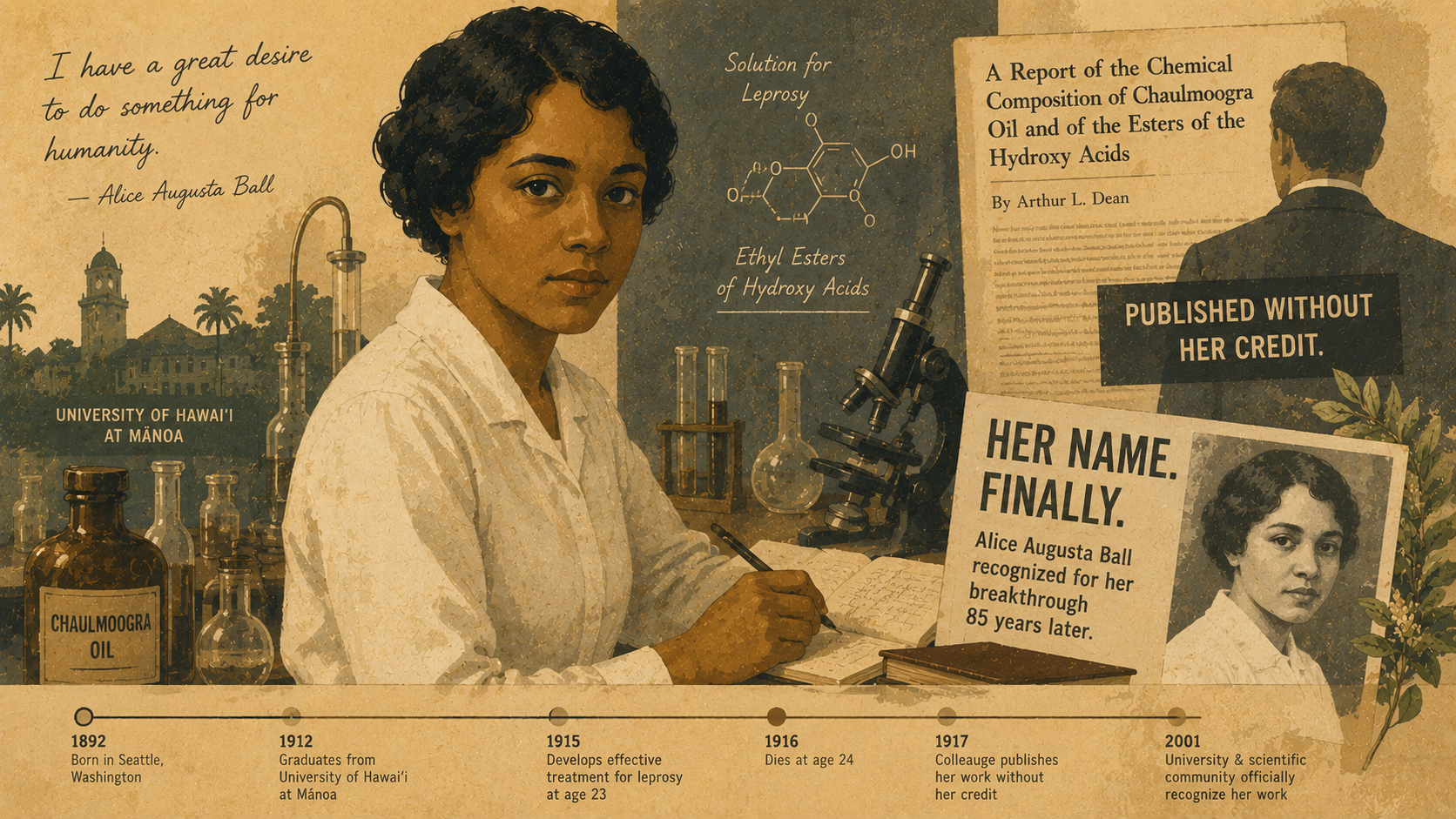
In 1915, a twenty-three-year-old Black woman named Alice Augusta Ball solved a problem that had defeated medical science for centuries.
Leprosy — known today as Hansen's disease — had been one of humanity's most feared and least understood illnesses for millennia. It was referenced in ancient Egyptian papyri. It shaped medieval European society, producing a class of legally defined outcasts who were required to carry bells to warn others of their approach. By the early twentieth century, modern medicine had made extraordinary advances across almost every disease category — and had made almost no progress at all on leprosy.
There was a reason for this. The bacterium responsible — Mycobacterium leprae — does not grow in laboratory cultures. It cannot be studied in petri dishes the way most pathogens can. It grows only in living tissue, making it extraordinarily difficult to research under controlled conditions. For centuries, the best available treatment was an oil derived from the seeds of the chaulmoogra tree — a remedy used in traditional Chinese and Indian medicine with some documented effectiveness at slowing disease progression. But chaulmoogra oil in its natural form was nearly impossible to administer effectively. It caused violent nausea when ingested. It could not be absorbed through the skin. And it could not be injected — its molecular structure made it immiscible with water, meaning it could not enter the bloodstream in a form the body could use.
Alice Ball found a way to make it work.
Through a process of chemical isolation and esterification — modifying the fatty acid chains of chaulmoogra oil's active compounds to make them water-soluble and injectable — she produced the first preparation of chaulmoogra oil that could enter the human bloodstream and be absorbed at therapeutic levels. The technique required advanced organic chemistry, precise laboratory work, and an understanding of both the chemical properties of the oil and the biological requirements of effective drug delivery.
She completed this work as a master's student. She was twenty-three years old. And she would be dead within two years — her contribution buried under someone else's name for nearly a century.
The Science Behind the Breakthrough
Understanding what Ball accomplished requires understanding what she was working against — and why her solution was not simply incremental but genuinely transformative.
Chaulmoogra oil contains a family of unusual fatty acids — hydnocarpic acid, chaulmoogric acid, and gorlic acid — whose cyclopentenyl ring structures give them their biological activity against Mycobacterium leprae. These compounds had been recognized as having therapeutic potential for centuries. The problem was delivery.
In its raw form, chaulmoogra oil could not be effectively administered to patients at therapeutic doses. Oral ingestion caused severe gastrointestinal reactions that made sustained treatment nearly impossible. Topical application could not penetrate deeply enough to affect systemic disease. Direct injection of the unmodified oil caused intense local reactions and could not enter systemic circulation because the oil's fatty acid chains were not water-soluble — they would not mix with blood plasma in a form the body could absorb and distribute to infected tissues.
Ball's solution was to modify the chemical structure of the fatty acids through esterification — a reaction that attached ethyl groups to the acid chains, transforming them into ethyl esters that were water-soluble and could be prepared as injectable solutions. The resulting preparation could be injected directly into patients, enter the bloodstream, and reach infected tissues throughout the body at concentrations sufficient to produce therapeutic effect.
The clinical results were documented. Patients who had shown no improvement with any previous treatment demonstrated measurable responses to the injectable preparation. Some patients showed sufficient improvement that they were released from mandatory isolation — a consequence of profound human significance given the conditions under which leprosy patients were being confined.
This was not a marginal improvement on existing treatment. It was the first clinically effective systemic treatment for leprosy in the history of medicine.
Ball completed the foundational research before her death in 1916. The technique she developed — later named the Ball Method by the physician who had commissioned her research, Dr. Harry Hollmann — remained the primary treatment for leprosy worldwide for approximately three decades, until sulfone antibiotic drugs replaced it in the mid-1940s.
During those three decades, the Ball Method was administered to thousands of leprosy patients globally. It was the standard of care. It was the treatment that gave patients their first medically grounded reason for hope.
Its inventor received none of the credit for most of that period.
The Theft
Alice Ball died on December 31, 1916, at the age of twenty-four. The cause of her death has never been definitively established. Some historical accounts attribute it to accidental chlorine gas inhalation during laboratory work — an occupational hazard that was not uncommon in early twentieth century chemistry. Others have noted that the documentation surrounding her death is incomplete in ways that reflect the broader pattern of insufficient institutional attention to Black lives and Black contributions.
What followed her death has been documented with greater clarity — and it is a story that illustrates, with particular directness, the mechanisms through which Black intellectual and scientific contributions have been systematically erased from the historical record.
Dr. Arthur Dean, the president of the University of Hawaii and Ball's academic supervisor, published the research she had developed on injectable chaulmoogra oil after her death — without crediting her. He named the technique after himself, referring to it in subsequent publications as the "Dean Method." He presented her findings, her chemical process, and the clinical results produced by her work as his own contribution to medicine.
Had it not been for Dr. Harry Hollmann — the physician at Kalihi Hospital who had originally asked Ball to work on the chaulmoogra problem and who understood the origin of the research — this erasure might have been permanent. Hollmann published a paper explicitly crediting Ball and naming the technique the "Ball Method," directly contradicting Dean's appropriation. But Hollmann's correction did not produce immediate historical restoration. Ball's name faded from the medical literature while Dean's continued to appear.
It was not until 1977 — sixty-one years after her death — that researcher Kathryn Takara began the historical work that would eventually restore Ball's name to her discovery. Recognition accumulated slowly across the following decades through the work of historians, scientists, and advocates committed to correcting the record.
The University of Hawaii formally recognized Ball's contributions in 2000 — eighty-four years after her death — with a historical marker and a portrait unveiled on the university's campus. In 2007, the state of Hawaii designated February 29 as Alice Ball Day — an official recognition of her contributions to science and to the history of the institution where she made them.
She had been twenty-three when she completed the work being recognized.
The Human Consequence: Kalaupapa and What the Treatment Meant
To understand why Ball's treatment mattered — and why its theft was not simply an act of academic injustice but of human consequence — it is necessary to understand what leprosy meant in the early twentieth century for those who carried the diagnosis.
The Kalaupapa settlement on the island of Molokai, Hawaii, was established in 1866 as a mandatory isolation colony for individuals diagnosed with leprosy. Between its founding and its closure as a mandatory facility in 1969, approximately 8,000 people were forcibly removed from their homes and families and confined to the remote peninsula, which was bordered on three sides by the Pacific Ocean and on the fourth by some of the highest sea cliffs in the world.
Residents of Kalaupapa were not patients in any conventional sense. They were exiles. Hawaiian law stripped them of legal rights. Their property could be seized. Their children could be removed at birth. Their correspondence was monitored and their mail was treated as potentially infectious. They lived in a community defined entirely by the diagnosis that had sent them there — separated from every social and familial connection by a disease that medicine had not yet learned to treat.
Ball's injectable preparation changed the clinical picture for some of these patients in measurable ways. Patients who showed sufficient improvement under the Ball Method were among the first to leave Kalaupapa — the first to experience, through a medical treatment, the possibility of returning to a life outside the colony.
The magnitude of what that meant — for the individual patient, for their family, for the community that had grieved their removal — cannot be fully captured in clinical terminology. It was a restoration of human possibility. And it was produced by the work of a young Black woman whose name was simultaneously being removed from the record of her own discovery.
The Pattern Ball's Story Represents
Alice Ball's erasure is not an isolated incident. It is one of the most clearly documented examples of a pattern that has repeated throughout the history of science, medicine, and technology when Black contributors — and Black women in particular — have produced work within institutions that had limited investment in ensuring their contributions were accurately credited.
Rosalind Franklin's X-ray crystallography work was essential to Watson and Crick's discovery of DNA's double helix structure — a discovery for which they received the Nobel Prize without Franklin, who died before the award was given and whose specific contribution to the foundational data was significantly understated for decades.
Henrietta Lacks, whose cancer cells were taken without her knowledge or consent in 1951 and became the HeLa cell line used in virtually every major area of medical research since — including the development of the polio vaccine, cancer research, and COVID-19 vaccine development — received no compensation, no credit during her lifetime, and no institutional recognition for decades. Her family received nothing from the billions of dollars of medical advancement her cells enabled.
Katherine Johnson, Dorothy Vaughan, and Mary Jackson — the Black women mathematicians whose calculations were essential to NASA's early space program — worked in a segregated computing section, had their contributions formally uncredited in official records, and were not publicly recognized until the 2016 book and film Hidden Figures brought their stories to mainstream awareness, decades after the work was done.
The consistency of this pattern across institutions, across disciplines, and across centuries is not coincidental. It reflects the structural reality that institutions designed and operated primarily by white men have historically had both the power and the incentive to assign credit in ways that served institutional and racial hierarchies rather than accurately representing the origin of contributions.
The Medical Legacy and Its Modern Relevance
The Ball Method was eventually replaced — not improved upon — by sulfone antibiotics beginning in the 1940s. The development of dapsone and its derivatives provided a more reliable and scalable treatment for Hansen's disease that did not require the complex preparation Ball's injectable formulation demanded.
But the significance of Ball's contribution extends beyond the period during which her specific technique was in use.
Hansen's disease remains a global health challenge. The World Health Organization reported approximately 202,000 new cases diagnosed globally in recent years, with the highest concentrations in India, Brazil, and Indonesia. The disease continues to cause permanent nerve damage, disability, and — in communities where stigma remains severe — social exclusion that echoes the Kalaupapa experience.
The chemical knowledge Ball developed — her work on the esterification of chaulmoogra fatty acids and their biological activity — contributed to the broader understanding of lipid-based drug delivery that continues to inform pharmaceutical development today. The challenge of making lipophilic compounds bioavailable through modification of their fatty acid chains — which Ball addressed in the specific context of chaulmoogra oil — is a fundamental problem in pharmaceutical chemistry that remains relevant to drug development across multiple disease categories.
Ball's master's thesis — on the chemical properties of the kava plant, Piper methysticum — has also received renewed scientific interest as researchers have examined kava's bioactive compounds for potential therapeutic applications. The chemical analytical methods she applied in that work reflected a sophistication that exceeded what might have been expected of a master's student at any institution in 1915.
What Her Story Demands
Alice Augusta Ball accomplished, at twenty-three, what institutions and researchers with far greater resources and recognition had been unable to accomplish for centuries. She did so as a Black woman in a scientific environment that provided no particular encouragement for her to succeed and significant structural incentives for her contributions to go unrecognized.
The erasure that followed her death was not accidental. It required specific choices — made by specific individuals within specific institutions — to publish her work under a different name, to allow that attribution to stand, and to maintain a historical record that assigned her discovery to someone else.
The restoration of her name to her discovery was not inevitable. It required the sustained work of historians and advocates who believed that the record mattered — that getting it right, even decades later, was worth the effort.
Both of those things are worth holding simultaneously.
The institutions that produce and validate scientific knowledge are not neutral. They have historically operated in ways that systematically undervalued, undercompensated, and underrecorded the contributions of Black scientists, women scientists, and Black women scientists in particular. That is a documented pattern with documented consequences for the individuals it affected and for the communities that lost the inspirational models their visibility would have provided.
Correcting that pattern — in historical retrospect and in current practice — requires the same commitment to accuracy that Ball brought to her laboratory work.
Her name was Alice Augusta Ball. She solved one of medicine's oldest problems before her twenty-fourth birthday. She did it with chemistry, with precision, and with the same intellectual rigor that her institution subsequently failed to bring to the question of whose name belonged on her discovery.
The record, finally corrected, should not require another eighty-five years to remember.
- Filed under
- History
- Reading time
- 11 min
- Author
- Editorial Desk