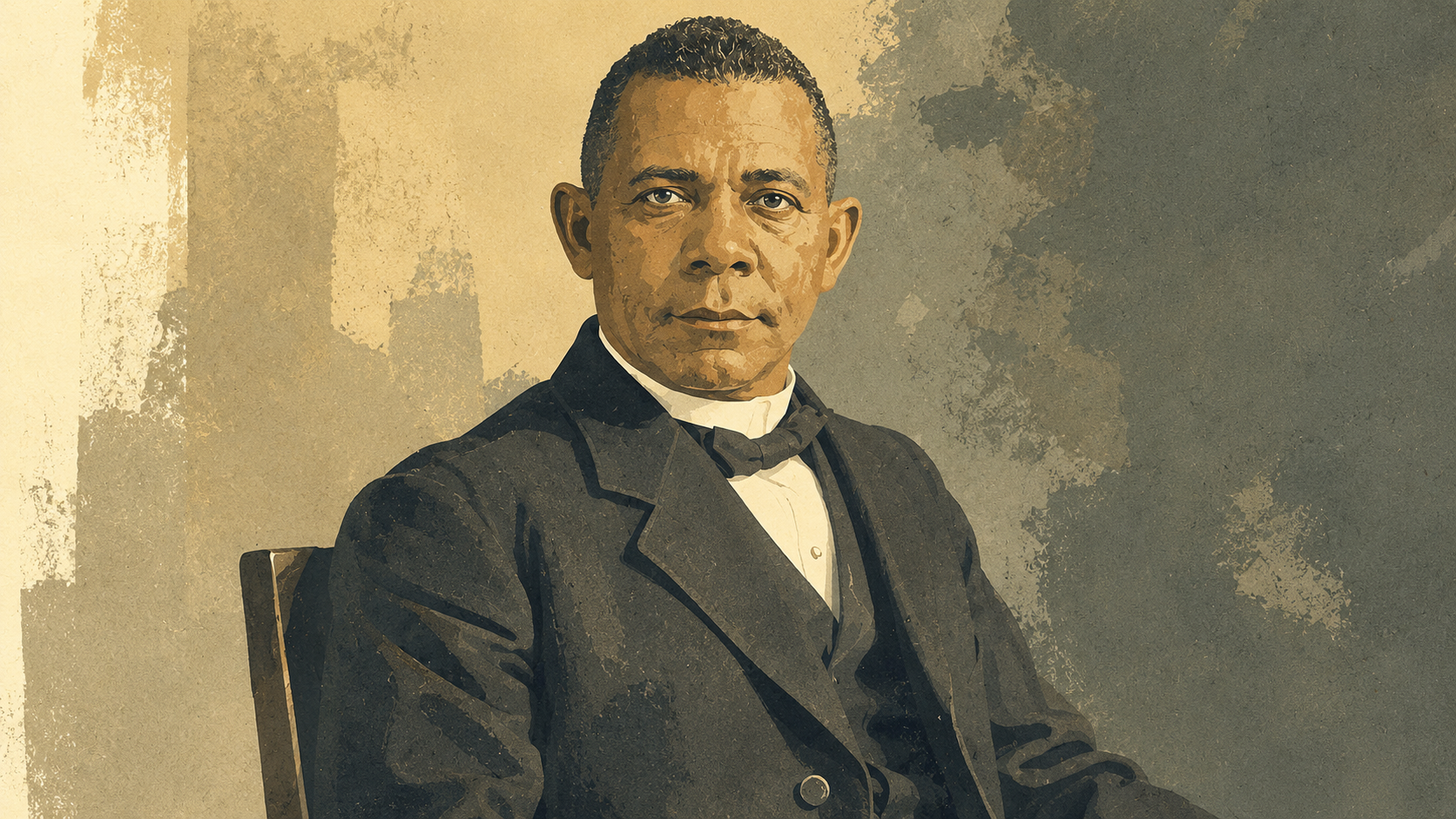
Few figures in American history have been more misread — by admirers and critics alike — than Booker T. Washington.
The standard account positions him as a pragmatist who traded civil rights for economic accommodation. Against W.E.B. Du Bois, who demanded immediate political and social equality, Washington is cast as the conciliator — the man who told Black Americans to cast down their buckets where they were, to master the trades, to build from within a system that denied them full humanity, and to defer the fight for full citizenship to a future generation.
That reading is incomplete in ways that matter enormously for understanding what Washington actually built — and why the infrastructure he created, not just the ideology he articulated, may be his most significant and most underappreciated legacy.
The Misreading of a Strategist
Washington operated inside one of the most dangerous periods for Black Americans in the country's history.
The decades following Reconstruction — the era in which he came to prominence — were defined by the systematic dismantling of the political gains Black Americans had made after the Civil War. Jim Crow laws formalized racial segregation across the South. Lynching was a regular instrument of racial terror, with documented killings occurring at a rate of more than one per week throughout the 1890s. The Supreme Court's 1896 decision in Plessy v. Ferguson enshrined the legal doctrine of separate but equal. The political and legal infrastructure of the country was actively working to return Black Americans to conditions as close to enslavement as law would permit.
Washington's response to this environment has been interpreted as accommodation. A more accurate reading is that it was strategy — the strategy of a man who understood that openly challenging white political supremacy in that particular moment invited destruction, and who chose instead to build Black economic and institutional infrastructure that could survive and compound across the conditions he could not immediately change.
His public posture was conciliatory. His actual work was foundational.
Tuskegee and the Dual Education Model
The Tuskegee Institute, which Washington founded in 1881 in rural Alabama, is typically described as a vocational school — a place where Black students learned trades rather than pursuing the classical academic education championed by Du Bois and the Talented Tenth framework.
This description is accurate but incomplete.
Washington's educational model at Tuskegee was deliberately dual in its design. Students learned practical skills — agriculture, engineering, construction, nursing, mechanics — because those skills produced immediate economic independence in a labor market where Black professionals were routinely excluded from white-collar employment. But the model also included academic instruction, leadership development, and preparation for roles as educators, business owners, and community leaders.
Washington was not anti-intellectual. He was strategic about what kind of intellect was most immediately useful in the specific conditions his students would face upon graduation. A classical education produced credentialed graduates who could not access the institutions their credentials theoretically qualified them to enter. Practical skills produced independent economic actors who could build without requiring white institutional permission.
The goal was not to limit Black ambition. It was to create conditions in which Black ambition could survive and compound in a hostile environment — and to do so by building the one thing that racial hostility would have difficulty destroying: demonstrated economic capability organized into community infrastructure.
Washington vs. Du Bois: Beyond the Binary
The debate between Washington and Du Bois is among the most analyzed conflicts in African American intellectual history — and it is almost always presented as a binary choice between two incompatible visions.
That framing obscures more than it reveals.
Du Bois's Talented Tenth argued that the development of a highly educated Black intellectual and professional class was the precondition for racial advancement. This class would lead, advocate, and model the full humanity of Black people to a white society that refused to acknowledge it. The argument was powerful and its motivations were genuine.
But Du Bois himself later acknowledged complexities in this framework that the binary debate typically omits. The Talented Tenth approach, applied in practice, produced real tensions around class within Black communities — the risk that an educated elite would develop interests and orientations increasingly distant from the mass of Black working people who most needed economic and institutional support.
Washington's emphasis on uplift of the broader community — through practical education, business ownership, economic self-sufficiency, and the creation of institutional infrastructure accessible to ordinary Black people, not just an educated elite — addressed a dimension of community development that the Talented Tenth framework sometimes underweighted.
The most honest reading of this debate is that both men were right about things the other was not fully addressing. Du Bois was right that political rights, legal equality, and intellectual development were not things that could be safely deferred indefinitely. Washington was right that economic infrastructure, practical education, and community self-sufficiency were not things that could wait for political conditions to improve before being built.
The tragedy of the debate is that it was framed as a choice. The Black community needed both — and still does.
The National Negro Business League and the Venture Capital Blueprint
Washington's most direct and most underappreciated contribution to Black economic infrastructure was the founding of the National Negro Business League in 1900.
The NNBL was, in structural terms, something that did not yet have a name in 1900: an organized network for supporting Black business development through resource sharing, mentorship, visibility, and community accountability. It connected Black entrepreneurs across industries and regions, provided a platform for sharing successful strategies, and created the institutional infrastructure through which Black business culture could develop and transmit itself.
At its peak, the NNBL had over 600 chapters across the country. It supported Black-owned banks, insurance companies, newspapers, retail establishments, and professional practices — the full range of economic activity that a self-sufficient community requires.
The modern equivalent of what the NNBL was attempting — organized capital, mentorship networks, community accountability, and a shared infrastructure for Black business development — is exactly what contemporary initiatives in Black entrepreneurship are still working to build. Washington identified the need more than a century ago and built a working, scaled version of the solution.
Black Wall Street and the Power of a Vision
One of the less recognized aspects of Washington's legacy is the cultural and economic vision he communicated — not just through institutional building, but through language and imagination.
The concept of "Black Wall Street" — the name associated with the thriving Greenwood District of Tulsa, Oklahoma — was not simply a geographic label. It was an aspirational frame that communicated something specific: that Black economic prosperity was not only possible but capable of reaching the scale and sophistication associated with the most powerful financial centers in the world.
Washington understood branding before the word existed in its modern form. He understood that communities are shaped not only by the institutions they build but by the visions they hold of what those institutions can become. Naming Black economic prosperity in terms that were expansive rather than apologetic was itself a strategic act — one that gave communities permission to build toward something larger than survival.
The destruction of the Greenwood District in 1921 — three years after Washington's death — did not disprove the vision. It confirmed its threat. The deliberate elimination of demonstrably successful Black economic infrastructure is not evidence that the infrastructure was built on a flawed foundation. It is evidence of how seriously that foundation was taken by those who sought to prevent it from compounding.
The Philosophy That Outlasted the Man
Washington's specific policy positions — particularly his public stance on civil rights agitation — were products of a specific historical moment, and evaluating them requires understanding that moment rather than applying contemporary standards retroactively.
What outlasts the specific positions is the framework beneath them: that Black advancement requires building, not only demanding. That infrastructure — economic, educational, and institutional — is not a substitute for political rights but a prerequisite for exercising them durably. That community self-sufficiency is not a ceiling but a foundation.
These principles are as relevant to the current moment as they were to Washington's. The racial wealth gap, the business ownership gap, the educational attainment gap, and the institutional infrastructure gap that Black communities continue to navigate are not problems that political advocacy alone will solve. They require the kind of deliberate, patient, generationally oriented infrastructure building that Washington dedicated his life to demonstrating was possible.
Contemporary movements toward Black economic empowerment — supporting Black-owned businesses, building Black digital infrastructure, developing Black financial institutions, creating Black educational alternatives — are direct descendants of the framework Washington articulated and institutionalized.
The specific applications are different. The underlying logic is the same.
A Blueprint, Not a Verdict
Washington was neither the saint his admirers claimed nor the sellout his critics charged.
He was a strategist operating under conditions of extraordinary constraint, building with the materials available to him, toward a horizon he understood would require generations to reach. He made choices that were defensible given his context and that produced real, lasting institutional results. He also made choices that can and should be criticized by those who believe the long-term costs of public accommodation outweighed its strategic benefits.
Engaging with his legacy honestly means holding both of those things simultaneously — taking seriously what he built, taking seriously the critiques of how he built it, and extracting from the full picture a framework that remains genuinely useful for the present moment.
The question Washington was always really asking was not about compromise or resistance. It was about what lasts. What can be built that survives, compounds, and provides the next generation with a stronger starting position than the one you inherited?
That is the question Black communities are still working to answer. And Washington's life — in all its complexity — remains one of the most instructive attempts to address it.
Essential Works and Further Reading
Up from Slavery — Washington's autobiography and one of the most widely read memoirs in American history. Essential for understanding the formative experiences and convictions that shaped his philosophy.
The Story of My Life and Work — A companion autobiographical account providing additional context on the development of his educational and economic philosophy.
The Future of the American Negro — A direct articulation of Washington's vision for Black economic and social advancement, written at the height of his influence.
- Filed under
- History
- Reading time
- 10 min
- Author
- Editorial Desk