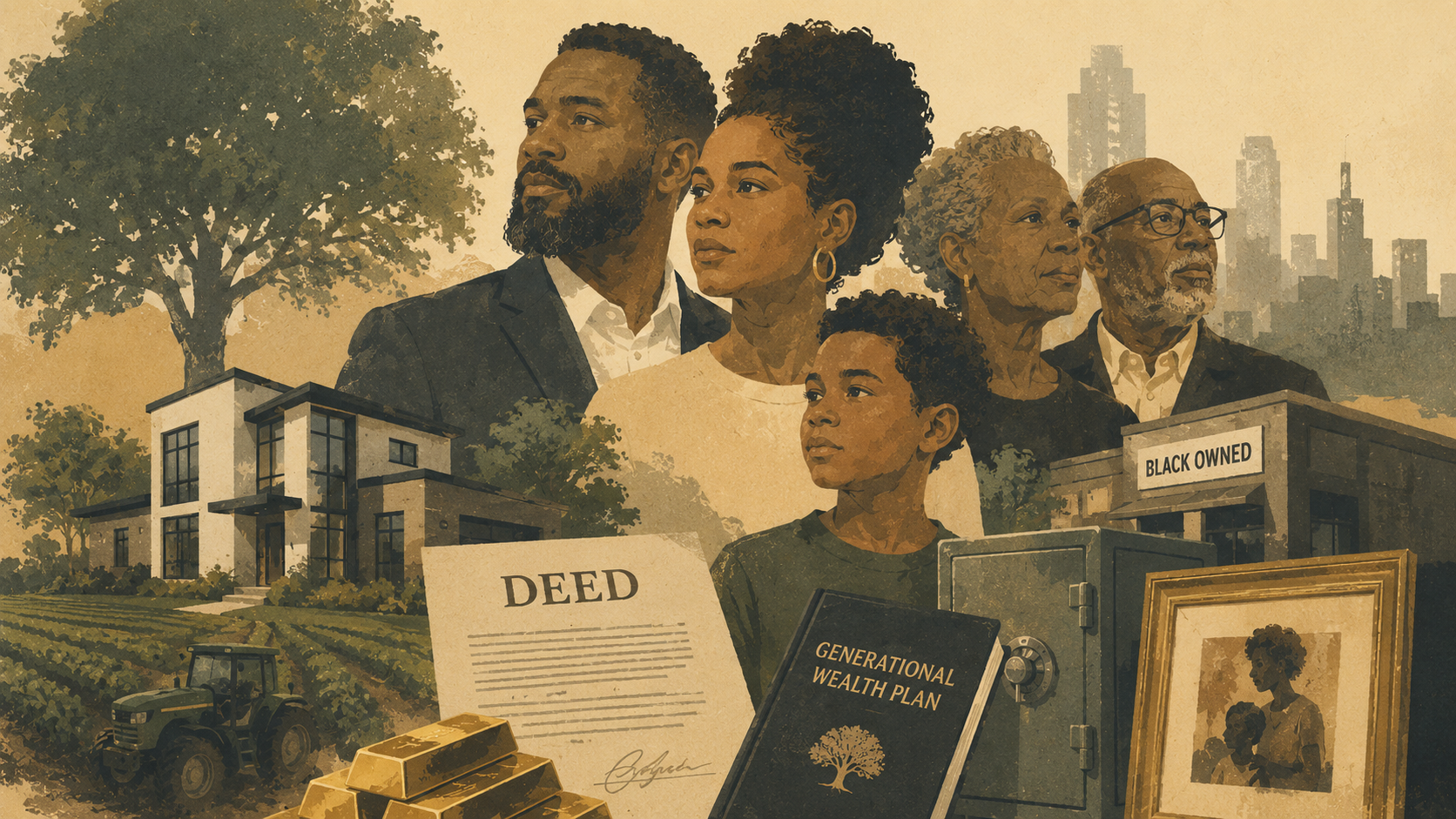
We have been taught to save money. To put it in accounts that earn fractions of a percent. To invest in markets we don't control, built by institutions that historically excluded us. And yet, the wealthiest families in the world — across every culture — share one common thread that rarely makes it into financial literacy workshops aimed at Black communities: they own things.
Not stocks. Not savings accounts. Things. Physical, tangible, irreplaceable things. Art. Land. Artifacts. Collectibles. Cultural objects that carry not just monetary value, but historical weight, scarcity, and permanence. Things that cannot be inflated away. Things that cannot be delisted. Things that can be held, passed down, and transferred across generations without permission from any institution.
This is not a conversation Black America is having loudly enough.
The Asset Class Nobody Talked to Us About
The global collectibles market is one of the most underreported wealth vehicles in modern finance. According to data from Art Basel and UBS, the global art market alone generates over $65 billion annually in sales. The broader collectibles market — encompassing sports memorabilia, historical artifacts, rare coins, vintage items, and cultural relics — is estimated to exceed $400 billion globally and continues to expand.
The alternative assets market, which includes collectibles, has outperformed the S&P 500 in several categories over the past two decades. The Knightsbridge Luxury Index, which tracks rare collectibles, reported returns that consistently rival or exceed traditional equities — with the added dimension of cultural and historical significance that pure financial instruments cannot replicate.
Yet Black participation in this market, both as buyers and as sellers with pricing power, remains disproportionately low. That gap is not a coincidence. It is a product of exclusion from the rooms where these conversations happen, limited access to authentication infrastructure, and a cultural narrative that has long steered Black wealth-building conversations toward consumer spending rather than asset acquisition.
That is beginning to change.
What Makes a Collectible an Asset?
Not every collectible becomes an asset. Understanding the distinction is where most people lose money — and where informed buyers create wealth.
An asset generates value over time. A collectible becomes an asset when four conditions are met:
1. Scarcity — The item exists in limited quantity. Whether that's a first-edition manuscript, a piece of game-worn memorabilia authenticated to a specific athlete, or a cultural artifact tied to a documented historical moment, scarcity creates a floor beneath the item's value.
2. Provenance — Verifiable history matters enormously. Who owned it, when, and under what circumstances? Provenance documentation transforms an interesting object into a traceable, legally defensible asset that can be insured, borrowed against, and transferred with confidence.
3. Cultural or Historical Significance — Items tied to moments, movements, or figures that carry enduring cultural weight appreciate differently than mass-produced goods. They carry narrative value — and narrative, when it belongs to a culture that has been systematically undervalued, tends to appreciate as recognition grows.
4. Graded Condition — Professional grading organizations like PSA (Professional Sports Authenticator), CGC, and PCGS provide standardized condition assessments that make items comparable, tradeable, and financeable. A graded asset can enter formal markets. An ungraded one cannot.
Black history — given its depth, its documentation challenges, its global scope, and its increasing recognition — produces items that carry all four of these dimensions simultaneously. The problem has never been a shortage of significant Black cultural objects. The problem has been infrastructure: who grades them, who authenticates them, who assigns them lasting market value, and who controls the ecosystem through which they're bought and sold.
The Collectibles That Black America Already Holds
Here is something worth sitting with: Black families across the country hold cultural artifacts that they don't know are assets.
A letter signed by a civil rights leader. A first-edition print from a Harlem Renaissance artist. Game-used equipment from a pioneering Black athlete who broke a barrier. Original pressings of records that defined a generation. Documents from the Great Migration. Photographs from communities that no longer exist.
These items sit in attics, storage units, and estate sales. They are passed over because the infrastructure to recognize, authenticate, and value them has been absent — or inaccessible to the communities that hold them.
The auction market tells a different story. In recent years:
Jean-Michel Basquiat's work has sold for over $110 million at auction, making him one of the highest-valued American artists in history.
Ali-signed memorabilia regularly fetches six to seven figures at major houses.
Early Black film and music ephemera has seen dramatic appreciation as cultural historians and collectors recognize the scarcity and significance of surviving documentation.
Objects tied to the civil rights movement have entered major auction houses with reserve prices that would have been unthinkable a decade ago.
The market is recognizing Black history's value. The question is whether Black ownership will be part of that appreciation — or whether the wealth generated by Black culture will continue to flow primarily to those outside the community who identified the opportunity first.
The Bridge Between History and Ownership
There is a difference between appreciating Black history and owning a piece of it. Appreciation is cultural. Ownership is economic. And the gap between the two is where generational wealth either gets built or gets lost.
The concept is not new. Jewish families have long understood that art and cultural objects serve as both heritage preservation and wealth storage. Asian families have structured jade, antiquities, and cultural artifacts as inheritance tools for generations. The ultra-wealthy across all cultures treat fine art as an investable asset class — using it for portfolio diversification, tax strategy, and long-term appreciation.
Black families, by contrast, have more often been sellers than buyers in these markets — liquidating heirlooms in moments of crisis rather than acquiring assets in moments of opportunity. That pattern is not a character failing. It is the predictable result of structural financial exclusion. When you lack access to traditional credit and generational capital, the objects you inherit become emergency funds rather than inheritance vehicles.
Breaking that pattern requires two things: education and access. And both are becoming more available than they've ever been.
Platforms Building the Infrastructure
The emergence of platforms dedicated to authenticating, grading, and connecting buyers and sellers within culturally significant collectibles is transforming access to this asset class. Where the process once required deep connections to established auction houses — institutions with their own historical exclusions — new infrastructure is making it possible to enter the market with greater transparency and lower barriers.
Platforms focused specifically on Black cultural heritage and artifacts are doing something more nuanced than simply enabling transactions. They are functioning as authentication infrastructure — helping to define what Black cultural objects are worth, building the provenance documentation that transforms interesting items into formal assets, and creating the market context in which buyers and sellers can transact with confidence.
Black Grail operates in exactly this space. As a platform focused on preserving and elevating cultural artifacts, collectibles, and relics rooted in Black history and heritage, it approaches this work not as nostalgia, but as asset infrastructure. The logic is straightforward: if the market for Black cultural objects is growing — and the data shows that it is — then the platform that helps establish grading, authentication, and market education within that space is helping to build the foundation on which Black wealth can compound.
The editorial bridge matters here because this is not simply about buying old things. It is about understanding which things carry value, why that value exists, and how to participate intelligently in a market that is maturing rapidly. That is education. And education is the precondition for ownership.
How Collectibles Fit Into a Wealth Strategy
For anyone thinking seriously about generational wealth, tangible assets deserve a place in the conversation alongside — not instead of — other vehicles. Here is a framework for thinking about it:
Start with what you know. The best collectibles investors are usually deeply knowledgeable about specific categories. Sports. Music. Film. Visual art. Historical documents. Choose a lane where your existing knowledge gives you an edge in identifying undervalued items.
Think in decades, not years. Collectibles are illiquid. They should be thought of as ten-to-twenty year holdings, not tradeable positions. The families who build wealth through tangible assets are not flipping — they are holding, protecting, and passing things down.
Authentication is non-negotiable. An ungraded, unauthenticated item is a personal possession. A professionally graded and authenticated item is an asset. The cost of professional grading is almost always worth it for items with real value potential.
Insure what you own. Tangible assets require proper insurance. This is an area where many new collectors underinvest. A piece that appreciates significantly needs coverage that reflects its current market value, not what you paid for it.
Document provenance from acquisition. Keep records of where you acquired items, what condition they were in, and any supporting historical documentation. Provenance is built over time and becomes more valuable the clearer and more complete it is.
Consider cultural trajectory, not just current market value. Black cultural history is in the early stages of broader global recognition. Items that document underrepresented figures, movements, and moments may be significantly undervalued today relative to where the market will be in twenty years. That gap is an opportunity — but only for those who act before it closes.
The Inheritance Play Nobody Talks About
Here is the conversation that is almost never had in Black communities: tangible assets can be transferred across generations in ways that financial assets cannot always replicate.
A well-authenticated, properly documented cultural artifact can be passed to a child or grandchild as an inheritance with clear provenance, documented value, and an established market for eventual sale. It does not require a brokerage account. It does not require a financial institution as an intermediary. It requires knowledge, documentation, and intention.
This is how old money operates. Not with great secrecy — but with infrastructure. They know what they own. They know what it's worth. They know how to transfer it cleanly. And they educate the next generation on what it is and why it matters.
The assets exist in Black families. The infrastructure to recognize and formalize them is being built. The market for Black cultural objects is expanding. The missing piece has always been the educational and institutional layer that connects those three things.
That is the layer worth paying attention to.
What This Means Right Now
The collectibles market is not waiting for Black America to catch up. It is moving. Auction prices for significant Black cultural objects are rising. Platforms are emerging that make authentication and market access more democratic. The historical record of Black contributions to art, music, sport, science, and culture is receiving greater scholarly and market attention than ever before.
The question is not whether this market has value. The question is who participates in capturing that value — as collectors, as sellers with pricing power, as educated buyers who understand what they're looking at, and as families who treat cultural objects as something worth acquiring and protecting.
Wealth built on culture is different from wealth built on abstract financial instruments. It is tangible. It is historical. It is, when done right, inseparable from identity. That combination — asset value and cultural meaning — is not available in any brokerage account.
It is only available in the things themselves.
- Filed under
- Capital
- Reading time
- 12 min
- Author
- Editorial Desk