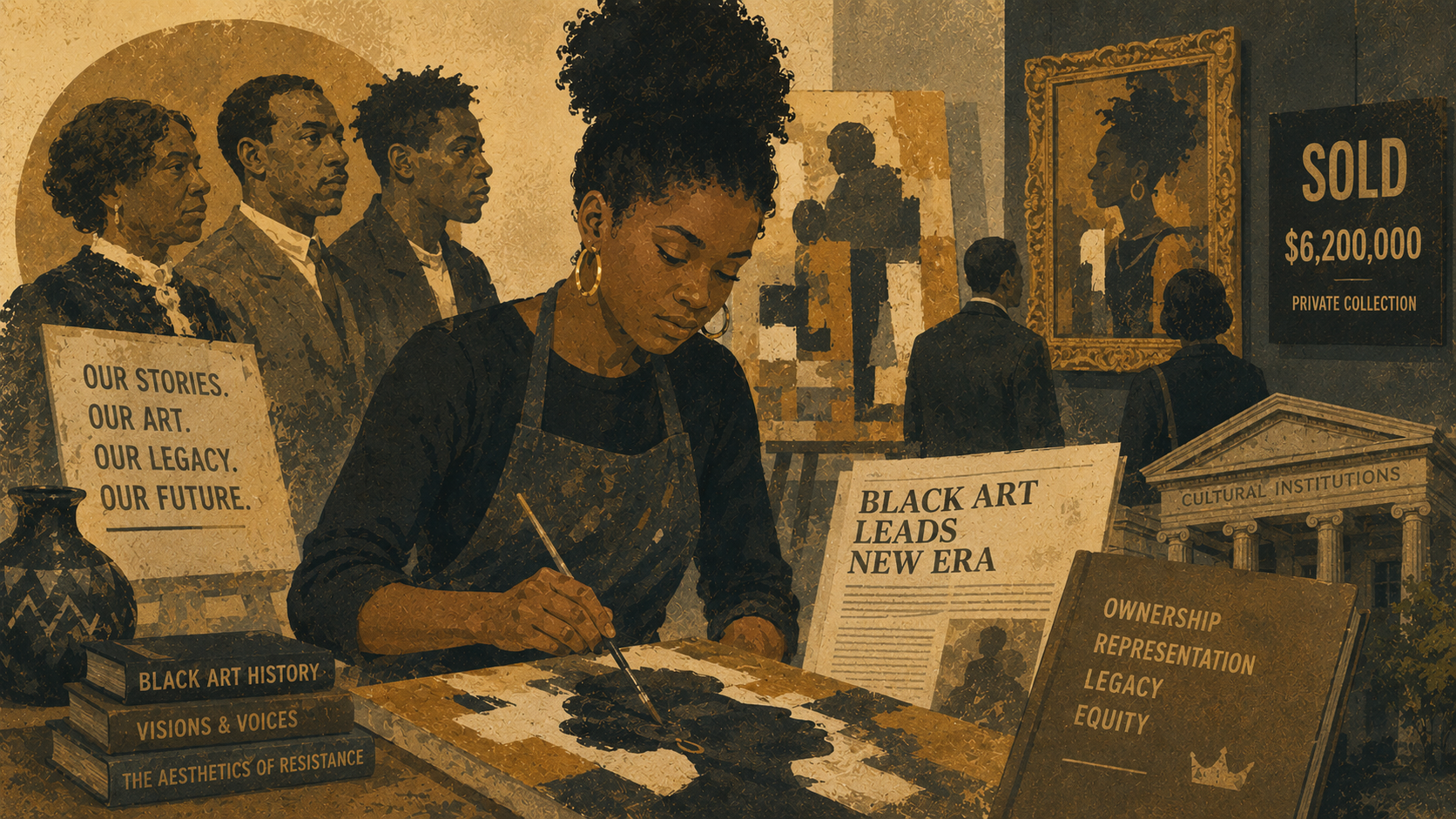
The global rise of Black art reflects more than a shift in market demand. It reflects a broader reassessment of cultural value, historical visibility, and artistic influence — one that has been decades in the making and is only beginning to register its full economic weight.
For generations, Black artists produced significant work while operating largely outside the institutional recognition, financial support, and archival infrastructure historically extended to their contemporaries. Museums, galleries, publishers, and auction systems frequently undervalued or overlooked contributions that are now increasingly recognized as foundational to modern art and visual culture.
That landscape has begun to change. And with it, so has the conversation around who profits — and who should.
The Reevaluation of Black Creative Work
Works by artists such as Jacob Lawrence, Jean-Michel Basquiat, Kerry James Marshall, Amy Sherald, and Lynette Yiadom-Boakye have become increasingly prominent within galleries, museums, private collections, and international auction markets. Their work has helped reshape conversations surrounding representation, historical memory, and the role of Black identity within contemporary art itself.
Yet the significance of this moment extends well beyond pricing alone.
Art markets often reveal broader cultural shifts before other institutions acknowledge them. The reevaluation of Black art reflects a growing recognition that Black creative expression has long functioned not only as aesthetic production, but as historical documentation, intellectual interpretation, and cultural preservation — doing the work of archives long before formal ones existed.
A Lineage That Was Always There
Much of this lineage traces through earlier movements that established the visual and intellectual foundations of Black American art.
The Harlem Renaissance stands as one of the most significant creative periods in American cultural history. Artists like Aaron Douglas and Jacob Lawrence developed visual languages centered on Black life, migration, labor, spirituality, and historical continuity. Lawrence's The Migration Series — sixty panels documenting the Great Migration of Black Americans from the rural South to the urban North — remains one of the clearest and most enduring visual narratives of twentieth-century Black transformation.
These were not peripheral contributions to American art history. They were its center. The institutional record simply took decades to reflect that reality.
Contemporary Artists Expanding the Tradition
The artists receiving international attention today are not beneficiaries of a trend. They are continuing a tradition of serious, rigorous, and culturally grounded visual thought.
Kerry James Marshall's large-scale paintings reinsert Black figures into artistic spaces from which they were historically excluded — his work is both a reclamation and a reframing of what Western painting has always had the capacity to hold.
Amy Sherald's portraiture explores identity, perception, and presence through restrained but psychologically layered compositions. Her ability to render Black subjects in ways that feel simultaneously monumental and intimate has made her work among the most recognized in contemporary American portraiture.
Lynette Yiadom-Boakye's fictional subjects occupy ambiguous narrative spaces that challenge conventional expectations surrounding portraiture and representation, creating a body of work that feels simultaneously timeless and deeply present.
Together, their ascent within institutional spaces signals something important: Black visual thought is being recognized not as a subcategory of contemporary art history, but as central to it.
Comic Art and the Expanding Definition of Cultural Value
Sequential art occupies a significant and often underappreciated place within this broader conversation.
For decades, artists such as Matt Baker and Billy Graham contributed to the visual evolution of American comics while receiving limited mainstream recognition relative to their influence. Their work helped shape visual storytelling traditions that continue to inform modern comics, illustration, animation, and popular culture — often without credit, and rarely with the financial compensation that influence warrants.
Contemporary creators like Sanford Greene continue expanding the medium through visually distinctive work that merges genre storytelling with cultural perspective and artistic experimentation. As collectors increasingly view original comic art as culturally and historically significant, the boundaries between fine art, illustration, and sequential storytelling continue to narrow — creating new categories of collectable and preservable Black artistic output.
This is a space where early recognition still carries real opportunity.
What the Market Is Actually Saying
Major sales involving Basquiat, Ernie Barnes, and other Black artists have drawn international attention — not simply because of their monetary scale, but because they signal changing perceptions regarding whose work is preserved, collected, and institutionally validated.
Basquiat's record-setting auction results — including a single work that sold for over $110 million — placed him among the highest-valued American artists in history. Ernie Barnes, whose work gained renewed visibility through popular culture, saw prices rise dramatically as collectors and institutions recognized the depth and originality of his contributions.
These are not anomalies. They are data points in a longer trend that has not yet reached its ceiling.
Art as Memory Infrastructure
The long-term significance of Black art may ultimately extend beyond auction records entirely.
Art functions as memory infrastructure. It preserves emotional texture, historical perspective, visual language, and cultural imagination across generations in ways that written archives alone cannot. Collections, exhibitions, patronage, and institutional validation therefore shape not only markets — they shape the historical record itself. They determine what survives, what gets studied, and what the next generation understands about who came before.
This is why the act of collecting Black art is meaningful in ways that exceed financial return.
For some, it represents genuine financial diversification within an asset class that has demonstrated consistent long-term appreciation. For others, it is an act of cultural stewardship — ensuring that work of significance remains in accountable hands. In many cases, it becomes both simultaneously. Prints, paintings, original comic art, photography, sculpture, and emerging digital forms all contribute to an expanding ecosystem of Black artistic preservation and ownership.
The Opportunity Is Structural, Not Sentimental
It would be a mistake to frame Black art collecting purely in emotional terms. The opportunity is structural.
Black creative output represents one of the most globally influential cultural forces of the past century — across music, visual art, literature, fashion, and popular culture. The institutions historically responsible for assigning formal value to creative work were slow, and in many cases resistant, to reflect that influence accurately. That gap between actual cultural impact and formal institutional recognition is narrowing.
When recognition catches up with reality, prices move. That dynamic — undervalued assets gaining formal recognition — is one of the clearest patterns in the history of art markets. Black art, across multiple categories and time periods, sits squarely within that pattern.
The broader opportunity is not simply to consume Black art. It is to preserve it, support the artists producing it, document its provenance, sustain the institutions capable of carrying it forward — and to own a piece of the cultural record before the market fully prices in what was always already there.
- Filed under
- Capital
- Reading time
- 9 min
- Author
- Editorial Desk