Why Black-Owned Restaurants Struggle While Black Food Culture Conquers the World
Black food built American cuisine. Black chefs are celebrated on every major platform. Black food culture shapes global trends. So why are Black-owned restaurants still among the most financially vulnerable businesses in the country — and who is actually profiting from the culture they created?
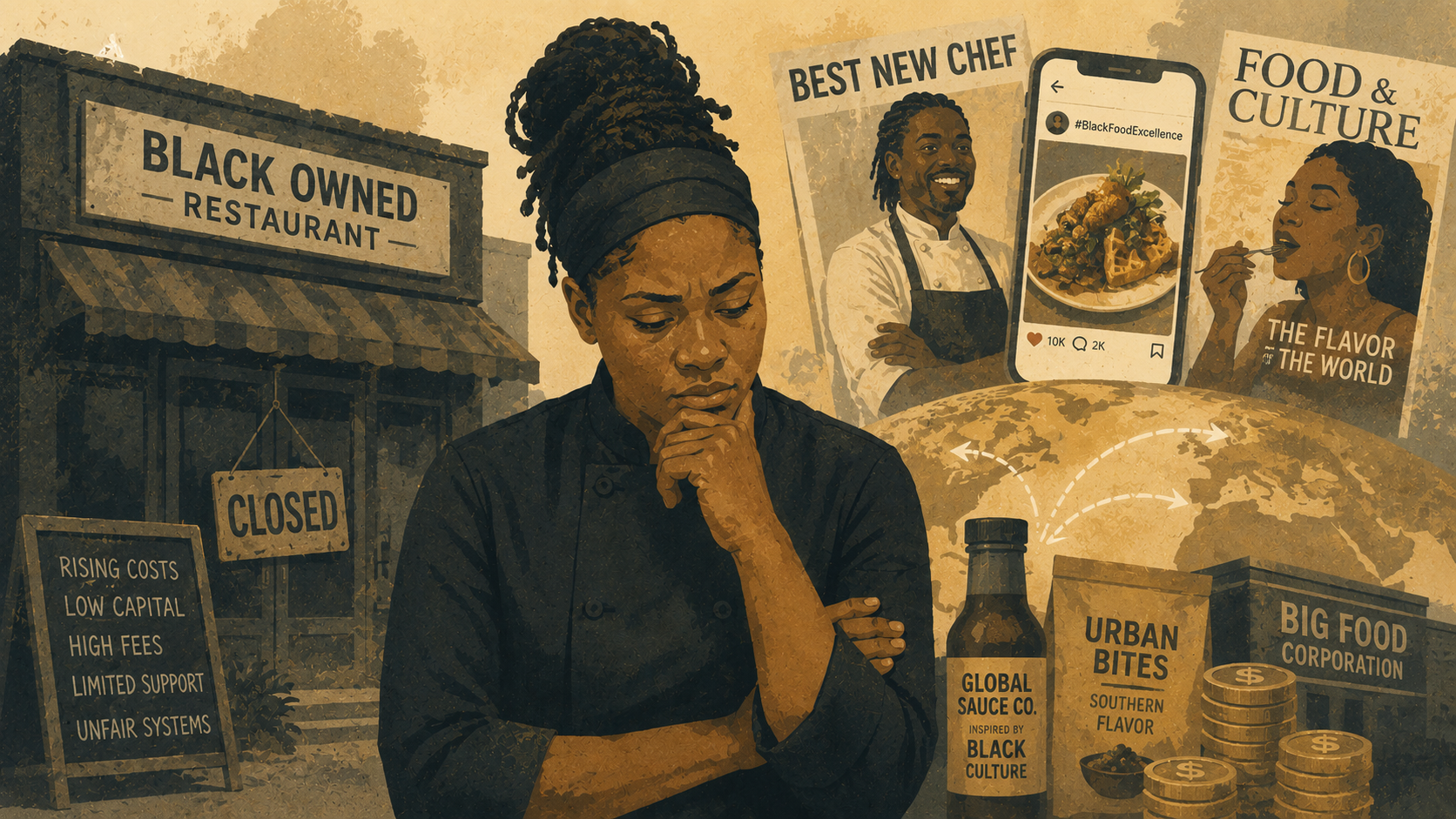
There is a paradox sitting at the center of American food culture that almost nobody names directly.
Black culinary tradition is everywhere. It is in the soul food that anchors Sunday tables across the country. It is in the barbecue that defines entire regional identities. It is in the techniques, the flavor profiles, the improvisational genius that transformed whatever ingredients were available — often the ingredients no one else wanted — into some of the most sophisticated and deeply satisfying food in the world. It is in the West African culinary traditions that survived the Middle Passage and quietly shaped the American palate for centuries before anyone thought to document them.
Black chefs are celebrated. Black food is photographed, hashtagged, reviewed, and featured. Food media has discovered — and rediscovered, and discovered again — the richness of Black culinary heritage with a regularity that suggests perpetual surprise.
And Black-owned restaurants are closing.
Not because the food is inferior. Not because the customers aren't coming. But because the infrastructure that converts cultural excellence into economic durability — the capital access, the real estate leverage, the investor networks, the media relationships, the operational systems — has not been built at the scale the culture deserves.
That gap, between cultural influence and economic ownership, is one of the most consequential and least discussed failures in Black economic life. And understanding it requires looking honestly at how the restaurant industry actually works — not how it appears from the outside.
The Numbers Behind the Experience
The restaurant industry is among the most challenging business environments in the American economy under any conditions.
Approximately 60% of restaurants fail within their first year of operation. Roughly 80% close within five years. Profit margins in the industry average between 3 and 9% — among the thinnest of any business category — meaning that minor disruptions in traffic, supply costs, or staffing can eliminate an entire month's profitability in a matter of days.
Black-owned restaurants operate within these industry conditions while carrying additional structural disadvantages that compound the baseline risk significantly.
Access to capital is the most fundamental challenge. Research from the Federal Reserve finds that Black business owners are twice as likely to be denied loans as white business owners with comparable financials — and when approved, they receive smaller amounts at higher interest rates. Restaurant businesses, which require significant upfront investment in equipment, build-out, inventory, and working capital before generating a single dollar of revenue, are particularly vulnerable to capital constraints. Undercapitalization at launch is one of the primary predictors of restaurant failure — and Black-owned restaurants are structurally more likely to open undercapitalized than their white-owned counterparts.
Real estate access and cost represent a second critical disadvantage. The neighborhoods where Black-owned restaurants are most naturally embedded — the communities they serve, the cultural contexts that give their food meaning — are increasingly subject to gentrification dynamics that raise commercial rents faster than restaurant revenues can absorb. A Black-owned restaurant that builds a loyal community following over five years can find itself priced out of its own neighborhood as that following attracts exactly the kind of attention that drives real estate values upward. The cultural value the restaurant helped create becomes the mechanism of its displacement.
The media and visibility gap has narrowed in recent years but has not closed. The restaurants that receive consistent coverage in major food publications, that get nominated for James Beard Awards, that generate the kind of national visibility that builds sustainable traffic — still skew significantly toward white ownership. The gap between the quality of Black culinary work and its representation in the media systems that translate quality into economic opportunity remains measurable and consequential.
The Cultural Extraction Problem
Here is the dynamic that most food industry coverage carefully avoids naming:
Black food culture generates enormous economic value. The question of who captures that value is a fundamentally different question from the question of who created it.
Barbecue is perhaps the clearest example. American barbecue — the slow-smoked, wood-fired tradition that has become a global culinary phenomenon — is rooted in African and African American techniques developed over centuries, refined under conditions of slavery, and perfected in the backyards, pits, and roadside establishments of Black communities across the South and beyond.
The fastest-growing barbecue restaurant chains in the United States are not Black-owned. The barbecue brands that have attracted significant venture capital investment, that have scaled to multiple locations, that have built the operational infrastructure for national franchising — are overwhelmingly white-owned. They are selling, at scale and with institutional backing, a cuisine whose foundational techniques were developed by people who have received neither credit nor economic participation in proportion to their contribution.
Soul food follows a similar pattern. The dishes that define the category — fried chicken, collard greens, black-eyed peas, cornbread, macaroni and cheese, sweet potato pie — were developed within Black communities, often by enslaved cooks whose labor fed the plantations that built American agricultural wealth. That culinary tradition is now sold at premium price points in upscale restaurants and fast-casual chains whose ownership and investor bases are predominantly white, often without meaningful acknowledgment of origin or economic participation by the communities from which the tradition came.
The global influence of Black American food culture on fast food, on flavor innovation, on the entire category of "comfort food" as a commercially viable concept, represents a cultural contribution whose economic value has been captured primarily by institutions with no meaningful connection to its origins.
This is not simply a historical grievance. It is a present-day economic dynamic with measurable consequences for Black-owned food businesses that are competing — undercapitalized and underrepresented in media — against well-funded enterprises building on cultural foundations they did not create.
What Black Food Media Built — and Who Monetized It
The rise of food social media — Instagram, YouTube, TikTok — created a genuine democratization of food visibility that benefited Black culinary creators significantly.
Black food content creators built massive audiences. Recipe creators, restaurant reviewers, culinary educators, and food storytellers with Black audiences in the millions emerged across every platform. Black food culture online is not a niche. It is a dominant force — in engagement, in trend creation, in the speed with which Black food content spreads across cultural and demographic lines.
The monetization infrastructure attached to that influence has been less equitable.
Brand partnership rates for Black creators with equivalent audiences have been documented as lower than those offered to white creators across multiple content categories, including food. Platform monetization algorithms have been shown to underperform for Black creators through mechanisms similar to those documented in other content categories — reach suppression, demonetization patterns, and recommendation algorithm disadvantages that reduce the revenue generated per view or engagement unit.
The cookbook industry — one of the primary ways food creators convert audience into durable intellectual property and passive income — has historically been slower to invest in Black food authors, with smaller advances, smaller print runs, and less marketing support than comparable white authors receive, even when the culinary content is equally or more compelling.
The cultural moment around Black food is real. The economic infrastructure supporting Black food creators and Black food businesses in capturing the value of that moment has not kept pace with the moment itself.
The Operational Gap Nobody Talks About
Beyond capital and visibility, there is a third category of disadvantage that Black-owned restaurants face that receives almost no attention in food industry coverage: the operational knowledge and network gap.
Successful restaurant scaling — moving from one location to multiple, from a local institution to a regional or national brand — requires access to specific operational knowledge: supply chain relationships, franchise development expertise, real estate negotiation experience, systems for hiring and training at scale, financial modeling for expansion.
This knowledge is not evenly distributed. It circulates through networks — investor relationships, industry associations, accelerator programs, mentorship pipelines — that have historically included very few Black food entrepreneurs. The white-owned restaurant group that has scaled to twenty locations has typically done so with access to advisors, investors, and operational expertise that Black-owned restaurants at equivalent culinary quality rarely encounter.
The James Beard Foundation, the most prominent institutional presence in American food culture, has made meaningful efforts in recent years to address the representation gap in its awards and programming. But the structural investment infrastructure — the venture capital, the private equity, the institutional lending — that actually funds restaurant scaling has been slower to change. A James Beard nomination generates visibility. It does not by itself generate the capital required to open a second location.
The Barbershop Comparison
The Black barbershop — which will be the subject of its own Black Digest examination — offers an instructive contrast with the restaurant industry.
Black barbershops have demonstrated remarkable economic resilience across generations, including through periods of significant economic disruption. The reasons are structural: relatively low capital requirements for entry, strong community loyalty that is culturally embedded rather than trend-dependent, a service model that generates recurring revenue from repeat customers, and a business identity so deeply tied to Black cultural life that it has proven resistant to the displacement dynamics that have affected other Black-owned businesses.
Black-owned restaurants, by contrast, face high capital requirements, thin margins, intense competition, trend-dependent traffic patterns, and a cultural identity that, paradoxically, makes them susceptible to the gentrification dynamics that extract value from Black cultural production and redistribute it to well-capitalized outside operators.
The comparison illuminates something important: the structural characteristics of a business matter as much as the quality of what it produces. Black food is extraordinary. The structural environment in which Black-owned food businesses operate has consistently worked against converting that excellence into durable economic ownership.
What Changes the Equation
The path toward economic durability for Black-owned food businesses runs through several specific structural changes — none of which require waiting for the broader system to transform itself before taking action.
Community economic circulation is the most immediately actionable lever. Research on Black consumer spending consistently finds that the dollar circulates within Black communities for a significantly shorter period before leaving — approximately six hours, compared to twenty days in Jewish communities and seventeen days in Asian communities, according to frequently cited economic research. Redirecting even a portion of Black food spending toward Black-owned establishments produces compounding economic effects within those communities over time.
Platforms that create structured visibility and verified discovery for Black-owned businesses — including restaurants — are building the infrastructure through which intentional economic circulation becomes easier and more consistent. BlackRefer's directory model addresses exactly this gap, creating the connective tissue between Black consumers and Black-owned businesses that increases the velocity of economic circulation within the community.
Access to patient capital — investment structured around the realities of restaurant economics rather than the expectations of venture capital — is critical for Black-owned food businesses attempting to scale. Community development financial institutions, Black-owned investment funds, and community investment models represent pathways that are more aligned with the operational realities of restaurant businesses than traditional venture funding.
Intellectual property and brand asset development represents an underutilized leverage point. The recipes, the techniques, the brand identities, and the cultural stories that Black-owned food businesses possess are assets that can be protected, licensed, and leveraged in ways that most Black food entrepreneurs have not been positioned to explore. Building those assets deliberately — trademarking, copyrighting, documenting provenance — creates long-term value that extends beyond the physical restaurant.
Media ownership and storytelling control matters enormously for a business category where visibility drives traffic. Black food creators and Black food businesses that build owned audiences — through newsletters, direct subscriber relationships, and owned digital infrastructure — are less dependent on algorithmic reach and better positioned to convert cultural following into consistent economic support.
The Longer Argument
Black food built American cuisine. That is not hyperbole — it is a historical fact supported by culinary historians, food anthropologists, and the documented record of what American eating actually looked like as it developed across centuries of Black culinary contribution.
The economic question is not whether that contribution has value. It clearly does — the market prices it every day. The question is who captures that value, who builds on that foundation, and what structures would need to exist for the communities that created the culture to participate equitably in the wealth it generates.
That is not a question with a simple answer. But it is a question that Black communities — as consumers, as entrepreneurs, as investors, and as the custodians of a culinary tradition of extraordinary depth and global influence — have both the right and the responsibility to ask clearly and pursue seriously.
The food is not the problem. The infrastructure is.
And infrastructure, unlike talent, can be deliberately built.
- Filed under
- Capital
- Reading time
- 12 min
- Author
- Editorial Desk