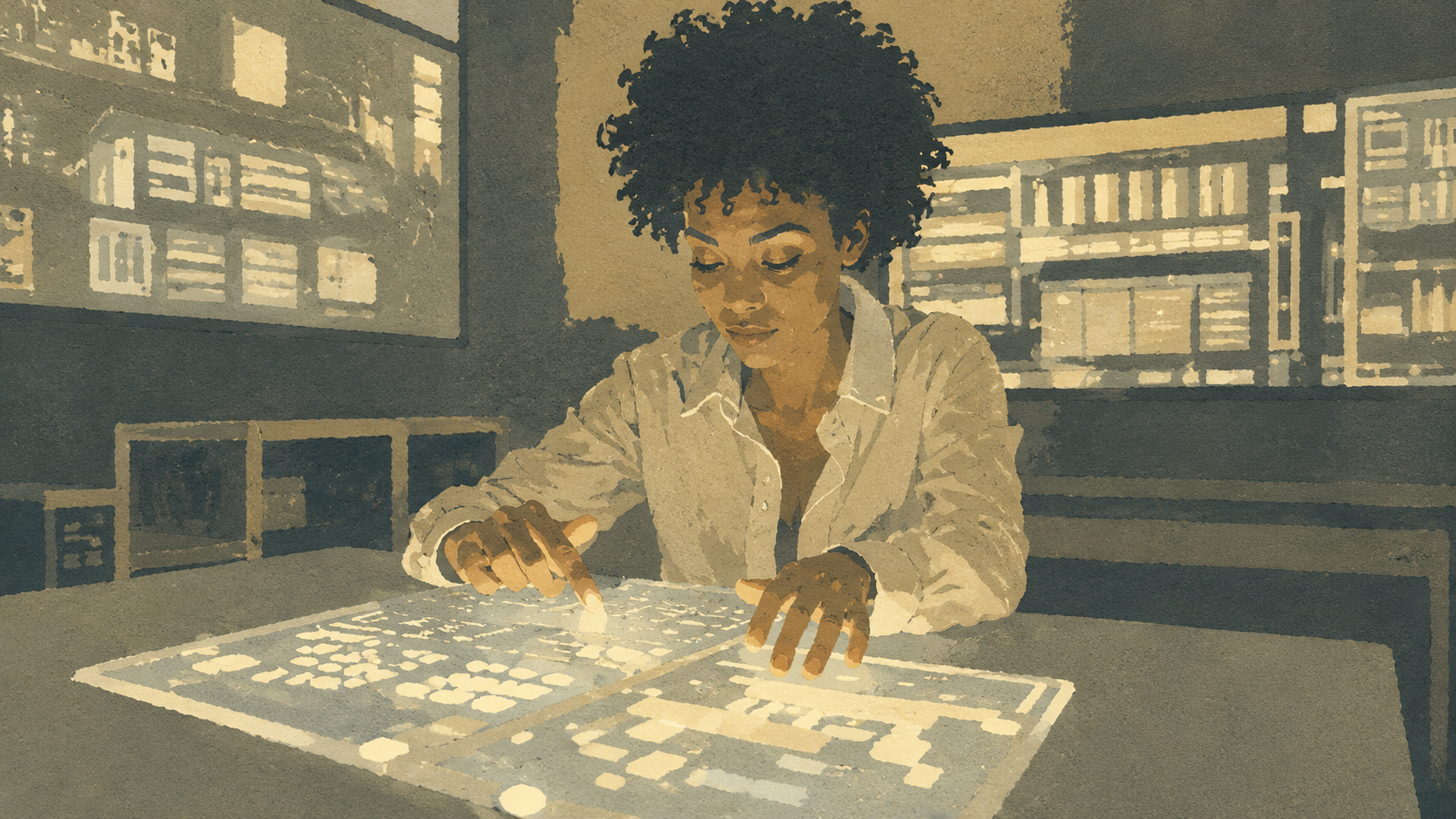
Every era develops its own form of territory.
Industrial economies were shaped by land, manufacturing, and physical infrastructure. The post-industrial era added intellectual property, brand equity, and media distribution. The digital era has introduced a new category of territory — one that most people participate in daily without recognizing it as something that can be owned, built, or lost.
Domains. Digital infrastructure. The systems through which ideas, audiences, and economic activity are organized online.
The question of who owns that infrastructure — and who operates on borrowed access within systems they do not control — is one of the most consequential and least discussed wealth questions of the current era. And for Black creators, Black businesses, and Black institutions, it carries stakes that extend well beyond technology.
The Platform Bargain Nobody Fully Explained
The modern internet offered a compelling trade when social platforms emerged as the dominant mode of digital communication: free distribution, global reach, and audience-building tools in exchange for data, attention, and behavioral insight.
For communities that had historically been excluded from mainstream media ownership and distribution infrastructure, the offer was genuinely appealing. For the first time, a Black creator, entrepreneur, or institution could build an audience of millions without requiring the approval of a legacy media gatekeeper.
That was real. And it mattered.
But the terms of the arrangement were asymmetric in ways that are now becoming visible.
Platforms own the distribution. Platforms own the algorithm. Platforms set the terms of engagement, determine reach, define what content is amplified and what is suppressed, and can alter any of these conditions at any time without notice. The creator builds the audience. The platform owns the infrastructure through which that audience is accessed.
This is not ownership. It is tenancy — and tenancy on terms set entirely by the landlord.
What Platform Dependency Actually Costs
The consequences of building entirely on rented infrastructure have become increasingly clear across multiple categories of Black digital presence.
The algorithmic reach problem. Research has documented consistent patterns in which Black creators experience disproportionate content suppression, demonetization, and algorithmic disadvantage across major platforms. A 2021 study by Twitter's own machine learning team found that the platform's photo-cropping algorithm disadvantaged Black faces relative to white faces. Meta has faced multiple documented instances of algorithmic suppression of Black content, including political speech during critical organizing periods. YouTube's demonetization systems have been repeatedly criticized for disproportionately affecting Black creators.
These are not isolated incidents. They reflect the structural reality that platforms optimize for their own metrics — advertiser comfort, engagement patterns, liability reduction — rather than the equitable distribution of reach across creators.
The policy change problem. Platform policy changes can eliminate years of audience-building overnight. Creators who built communities on Vine lost them when the platform shut down. The consistent tightening of organic reach on Facebook forced businesses and publishers to pay for access to audiences they had already earned. Twitter's acquisition and subsequent restructuring cost many accounts the reach and verification status they had accumulated over years of consistent building.
The monetization dependency problem. Black creators generate enormous cultural and economic value for platforms — in music, comedy, fashion, food, education, and politics. Yet the monetization infrastructure that captures that value flows predominantly through platform systems that extract a significant share before creators receive anything. An independent platform with a direct audience relationship — and a direct revenue relationship — retains economics that platform-dependent creators consistently surrender.
The Domain as Digital Property
A domain is, at its most basic level, a web address. But its functional significance in a digital economy extends well beyond navigation.
A domain is a permanent, portable, independent point of digital identity. Unlike a social profile — which exists within a platform's architecture and can be suspended, suppressed, or eliminated at that platform's discretion — a domain belongs to its owner. It can be moved to different hosting infrastructure. It can outlast any single platform. It creates a stable, ownable address for an audience, an archive, a business, or an institution.
The mailing list attached to a domain carries similar properties. An email list is not subject to algorithmic reach restrictions. It delivers directly to the subscriber. It cannot be deplatformed. It does not require paying a platform to reach the audience it has already earned. It is, in the language of digital business infrastructure, owned media — as distinct from earned media (organic platform reach) or paid media (advertising).
The compounding value of owned digital infrastructure is measurable. Businesses and publications with strong direct audience relationships — through owned domains, email lists, and independent publishing infrastructure — consistently demonstrate greater resilience, greater monetization flexibility, and greater long-term enterprise value than those dependent on third-party platform access.
Domain names themselves have become a recognized asset class. Premium domain sales regularly transact in the six and seven figures. Domains tied to category-defining terms, culturally significant language, or established brand identity carry demonstrable market value independent of whatever is built on them.
For Black entrepreneurs investing in domain portfolios — particularly those tied to Black cultural identity, Black business categories, or Black institutional language — this represents an asset play that most mainstream financial conversations have not yet adequately addressed.
The Cultural Preservation Dimension
For Black communities specifically, the question of digital infrastructure ownership carries dimensions that extend beyond business strategy.
The digital era is producing the most voluminous record of Black cultural life in history — in music, comedy, political speech, visual art, fashion, food, education, and community conversation. The question of where that record lives, who controls it, and what happens to it when platform terms change is a preservation question with historical consequences.
Much of Black Twitter's most culturally significant discourse exists in archives that Twitter now controls — or has structurally degraded through API restriction and platform changes that have made third-party archiving increasingly difficult. Conversations that shaped public understanding of police violence, political organizing, cultural movements, and community experience are housed in infrastructure that the communities who created them do not own.
This pattern repeats across platforms. Black creators produce culture. Platforms capture the infrastructure through which that culture circulates. The economic and archival value accumulates in systems outside the community's control.
Independent digital infrastructure — owned domains, owned archives, owned publication platforms, owned email relationships — creates an alternative. It does not eliminate platforms from the equation. It ensures that platforms are not the only equation.
The AI Acceleration and What It Changes
The arrival of AI-generated content at scale changes the strategic calculus around owned digital infrastructure in important ways.
As artificial intelligence accelerates the production of content across the internet — generating articles, social posts, product descriptions, and marketing copy at volumes that human creators cannot match — the information environment is becoming dramatically more saturated. The volume of content competing for attention is increasing faster than human capacity to evaluate it.
In this environment, trusted destinations become more valuable, not less. When content is abundant, curation matters. When information is automated, authentic voice and consistent perspective become differentiating assets. When algorithmic feeds are full of generated content, direct relationships with human audiences become worth protecting.
A domain with a recognized identity, a consistent editorial perspective, a direct subscriber relationship, and an established archive of original content is precisely the kind of asset that becomes more valuable as the surrounding environment becomes noisier. It is not competing with AI-generated content on volume. It is competing on trust — and trust compounds in ways that volume cannot replicate.
What Building Looks Like in Practice
The shift from platform dependency to owned digital infrastructure does not require abandoning social platforms. It requires using them differently — as distribution channels that point back to owned infrastructure rather than as the infrastructure itself.
The model that sustains independent digital businesses over time typically follows a consistent pattern:
Own the domain. Establish a permanent, independent point of digital identity that exists outside any single platform's architecture. Build toward it, not away from it.
Build the list. An email subscriber who came directly to your owned infrastructure is worth significantly more over time than a follower on a platform you do not control. The list is the asset. The follower count is the vanity metric.
Publish consistently in your own space. Original content published on an owned domain builds search visibility, archival depth, and institutional credibility in ways that platform content cannot. It creates a body of work that exists independent of algorithm changes.
Use platforms for discovery, not dependency. Social platforms remain powerful for reaching new audiences. The strategic shift is ensuring that those audiences have a pathway to owned infrastructure — a subscription, a mailing list, a direct community — rather than existing only within the platform.
Treat domain assets as long-term investments. Category-relevant domains, culturally significant terms, and brand-adjacent addresses appreciate over time as digital real estate markets mature. For communities with the foresight to acquire them before that appreciation is fully priced in, they represent meaningful asset positions.
The Longer View
The future of digital influence may belong less to those who temporarily capture attention on platforms they do not control, and more to those who build infrastructure capable of sustaining trust, identity, and direct audience relationships over time.
Attention is rented. Infrastructure compounds.
A profile can disappear. An archive endures. A mailing list is yours. A domain is property. And property — owned, maintained, and developed with intention — is one of the most durable forms of wealth any individual, business, or community can build.
For Black businesses, creators, and institutions navigating a digital environment shaped by others' incentives, the act of owning infrastructure is not simply a technical decision.
It is a declaration of long-term intent.
- Filed under
- Capital
- Reading time
- 9 min
- Author
- Editorial Desk